Internationalization Seminar @ 2026
Local Roots: Global Minds – Building Pathways from Level 5 to Level 6
Fagskolen Rogaland, Stavanger | 23–24 September 2026
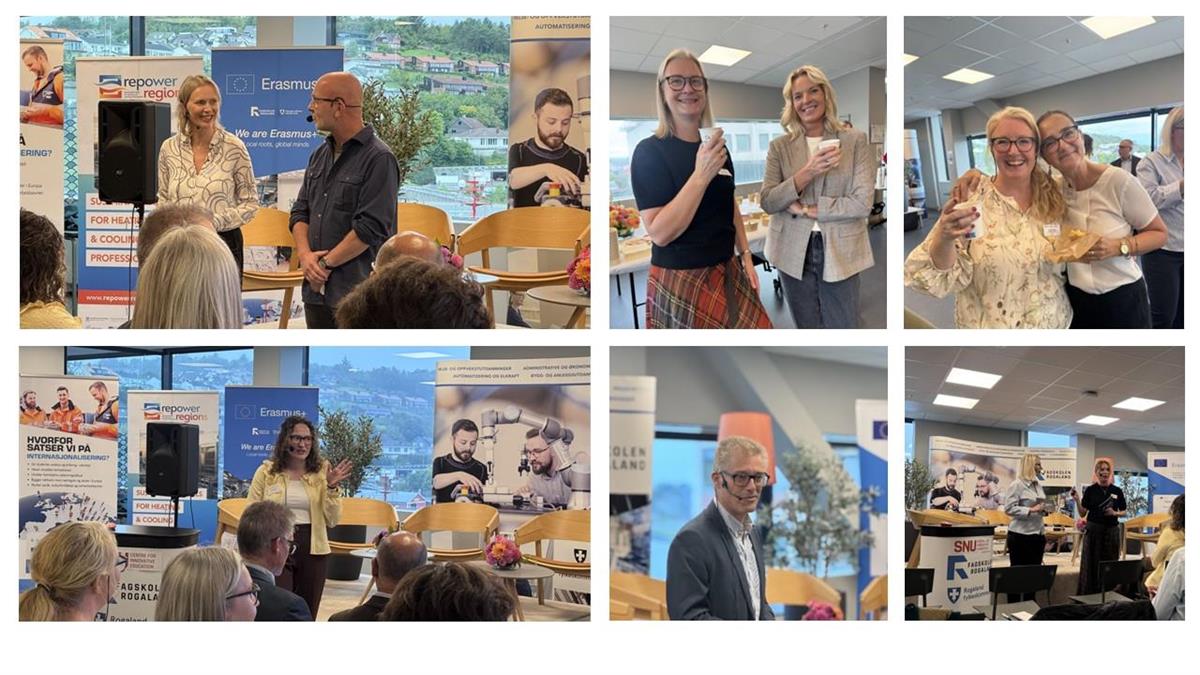
For the third consecutive year, Fagskolen Rogaland hosted its Internationalisation Seminar for Higher Vocational Colleges, bringing together educators, institutional leaders, policymakers and international partners to explore opportunities for cooperation and educational progression.
Under the theme Local Roots: Global Minds, this year's seminar focused on international pathways from Level 5 to Level 6, highlighting the role of experience, work-based learning and international collaboration in creating more flexible educational opportunities.
The seminar opened with a welcome from Rector Jone Johnsen, followed by a special video address from Sigrun Aasland, Norway's Minister of Research and Higher Education, who was unable to attend in person.
International perspectives were central to the programme. Representatives from the Polytechnic Institute of Maia, Portugal, and Artevelde University of Applied Sciences, Belgium, shared insights into educational progression, institutional cooperation and teaching and learning across qualification levels. Colleagues from Fagskolen Rogaland, Fagskolen Viken and Fagskolen Innlandet contributed practical experiences of international projects, staff mobility and institutional internationalisation.
The second day featured a panel discussion and interactive roundtables, encouraging participants to exchange experiences and explore practical approaches to strengthening pathways between Levels 5 and 6. Beyond the formal programme, a visit to the historic Utstein Kloster and a networking dinner at Stavanger Concert Hall offered further opportunities for networking and international cooperation.
The seminar highlighted how international collaboration can connect institutions, strengthen educational pathways and create new opportunities for students and working life.
Internationalization Seminar @ 2025
Students’ involvement and benefits from international collaboration
Fagskolen Rogaland, Stavanger – 26–27 August 2025
Fagskolen Rogaland spearheaded by the Centre for Innovative Education successfully hosted an international seminar focusing on students’ involvement and the benefits of international collaboration in higher vocational education. The two-day event brought together representatives from vocational colleges, educational authorities, and international partners to share experiences, discuss challenges, and explore new opportunities for cooperation across borders.
Throughout the seminar, participants gained valuable insights into the role of internationalisation in higher vocational education and training. Presentations covered topics such as the relevance of global partnerships, strategies for quality enhancement, and the student perspective on international experiences. Among the speakers were Professor Ellen Vea Rosnes (VID University), Else Kathrine Nesmoen (HK-dir), Kristof Punie (Artevelde University of Applied Sciences), and Ernst Olsen (NORA), along with several representatives from Fagskolen Rogaland and partner institutions.
The programme also included interactive case studies, a panel discussion, and round table sessions where participants exchanged best practices and ideas for future collaboration. In addition to the professional content, attendees enjoyed a guided tour of Stavanger and a joint dinner at Spiseriet, Stavanger Concert Hall — providing a perfect setting for informal networking and inspiration.
The seminar concluded with reflections on the future of internationalisation in higher vocational education and a shared commitment to continued cooperation and student engagement across borders.

Internationalization Seminar @ 2024
We hosted our first Internationalisation Seminar for Norwegian Hvet Colleges on 16-17 September 2024, bringing together experts and educators to promote quality, development, and cooperation within higher vocational education.
Over two days, participants engaged with national and international guest speakers, who shared their insights and experiences in internationalisation. The event featured dynamic panel discussions and practical workshops, fostering meaningful dialogue and collaboration.
A key takeaway was the importance of strengthening networks among institutions, ensuring that internationalisation remains a driving force in enhancing vocational education. Our keynote speakers:
Else Kathrine Nesmoen, Head of Department for Higher VET, HK-dir
Professor Marte W. Solheim, Vice-Rector for Innovation and Society, UiS
Maxine Semple, Associate Director for Global Engagement, Niagara College, Canada
Boudewijn Grievink, Program Manager Internationalisation, Katapult, Netherlands
Rui Baltazar, International Coordinator, Eagle Intuition, Portugal
Hege Fjeld, Senior Advisor, International Coordinator, Fagskulen Vestland
Thank you to all who contributed to this inspiring and productive seminar! 🌍✨

Faroe Islands, Iceland, Norway and Greenland
Nordic Geothermal Green Shift – A New Chapter in Nordic Cooperation
Project name: Nordic Geothermal Green Shift
Acronym: FING
Project duration: September 2026 – August 2028
Project funded by: Nordplus Adult – https://www.nordplusonline.org/
Grant Agreement nr: NPAD-2026/10054
Coordinator: Fagskolen Rogaland (Norway)
Partners: Vinnuháskúlin (Faroe Islands), KTI Sisimiut (Greenland) and Akureyri Comprehensive College (Iceland)
Project website: https://www.greenfing.com/home
About the project
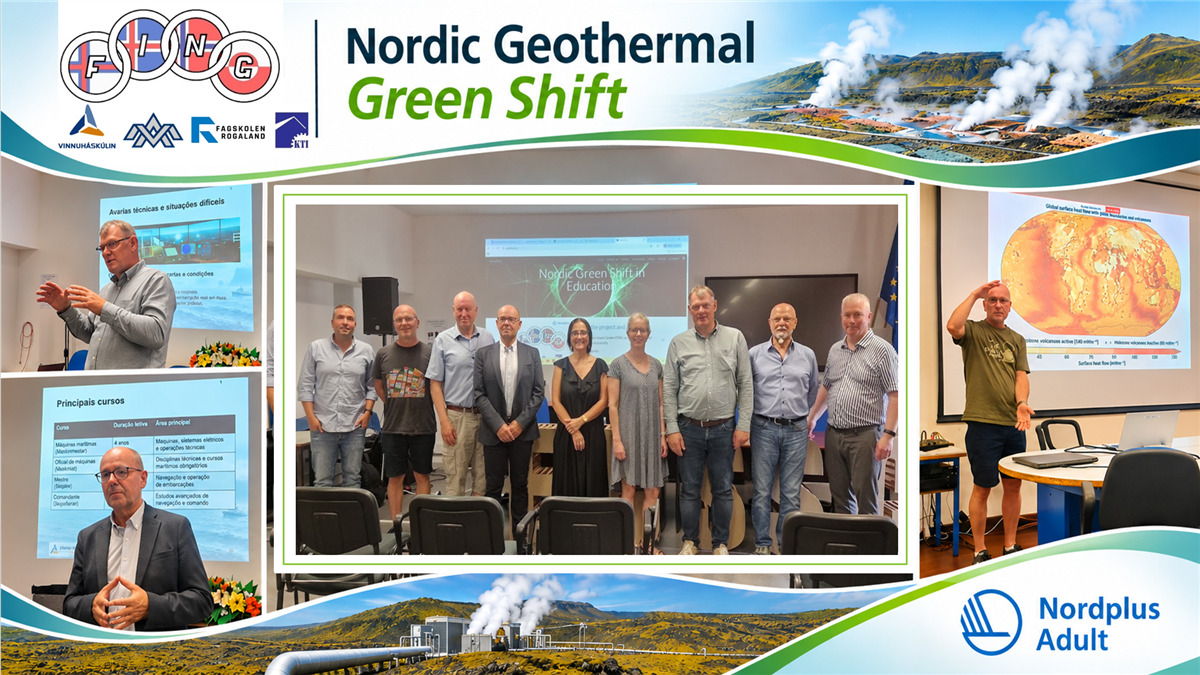
Building on a longstanding Nordic partnership established in 2012, Fagskolen Rogaland and its partners in the Faroe Islands, Greenland and Iceland have launched a new Nordplus Adult project, Nordic Geothermal Green Shift, continuing their collaboration in vocational education and sustainable development.
The project focuses on connecting existing technical and vocational education with geothermal energy and sustainable energy solutions, with particular attention to the needs of Nordic and Arctic communities.
Project objectives and activities
The main objective is to strengthen the capacity of vocational educators to integrate geothermal energy and sustainability into adult education.
The partners will map existing competences, courses and teaching resources, develop a shared Nordic pedagogical framework and create four to six short, practical learning modules based on real-life examples from Nordic and Arctic contexts.
The modules will be tested across the four partner institutions and made openly available to support teachers, trainers and adult learners.
The project also includes international learning activities in Stavanger, Norway, and Akureyri, Iceland, providing opportunities for knowledge exchange, professional development and practical learning.
Through this initiative, Fagskolen Rogaland continues to strengthen international cooperation and contribute to the development of relevant skills for the green energy transition.
____________________________
Norway, Faroe Islands, Iceland and Canada
Project name: Green education empowering communities
Acronym: FARE Green
Project duration: This is a 3 year project (YEAR 1: 01 September 2024 to 31 August 2025)
Project funded by: NORA (North Atlantic Cooperation) Link: https://nora.fo/?_l=en
Partners:
- Fagskolen Rogaland, Stavanger (coordinator)
- Fagskulen Vestland (FV), Bergen: https://www.fagskulen.no/
- Center for Lifelong Learning (MSS), Reykjanesbær: https://www.mss.is/
- Niagara College (NC), Niagara: https://www.niagaracollege.ca/
- Go Local, Tórshavn: https://golocal.fo/
- EMZ, Reykjanesbær
The project targets small Nordic towns, particularly coastal areas, addressing challenges like population decline and economic limitations. It promotes responsible tourism practices that preserve cultural and natural heritage while creating opportunities by leveraging local skills and resources.
Collaboration between Nordic communities fosters knowledge exchange, addressing shared challenges and supporting sustainable regional growth.
The specialized vocational training programs under development are designed to meet the specific needs of local industries and communities, ensuring relevant skills and knowledge. Small-scale tourism projects are developed to be locally managed, sustainable, and culturally respectful, often involving community-based experiences.
Project priorities:
1. Development of tailored VET learning programs
2. Focus on small-scale tourism initiatives
3. Target small Nordic communities
4. Contribute towards enhancement of sustainability in tourism
5. Strengthening local economies
6. Improve integration across Nordic regions
Project web page: https://faregreen.org/

_______________________________________________
Faroe Islands, Iceland, Norway and Greenland
Project name: Nordic green shift in education
Acronym: GREEN FING
Project duration: September 2023 to August 2025
Project funded by: Nordplus: https://www.nordplusonline.org/
Partners: Vinnuháskúlin (Faroe Islands), Greenland School of Raw materials (Greenland), and the Comprehensive College in Akureyri (Iceland)
In this new initiative - "Nordic Green Shift in Education", we understand the term "green shift in teaching" to refer typically to a shift in educational practices and approaches that prioritize environmental sustainability and ecological awareness. It involves integrating sustainability principles and environmental education into the curriculum and teaching methods.
The green shift in teaching emphasizes the importance of ecological literacy and encourages students to develop a deeper understanding of environmental issues and their role in creating a more sustainable future.
Our main objectives are firstly, to create an innovative quality network for educators primarily in the provision of VET within green growth, climate change and sustainable development. Secondly, we wish to produce a "Green Shift Teaching Handbook" which offers practical "green shift teaching" modules for teaching and learning pedagogies and methodologies, from multi- and inter-disciplinary approaches.
As our FING partnership started over 10 years ago, we will use the acronym GREEN FING for this new project.
Project web page: https://www.greenfing.com/home

_______________________________________________
Poland/ Norway
Project name: Empowering Youth Vocational Skills for Automated Metal Industry – adjusting vocational education to demands of metal machining industry of the future
Acronym: skills4ami
Project duration: January 2022 to August 2023
Project funded by: EEA Grants
Project partners: Radom Chamber of Commerce (Poland) and EduExpert (Poland)
Funding was allocated for institutional cooperation for the improvement of quality and relevance of Vocational Education and Training (VET) and vocational continuing education.
The aim of the project was to develop and create a modern educational platform supporting youth in choosing a career related to the technical industry. The platform is rooted in current VET programs (including dual education), also complementing them in terms of specific competence gaps indicated by practical vocational teachers and entrepreneurs.
Project page: https://skills4ami.eu/

_______________________________________________
Faroe Islands, Iceland, Norway and Greenland
Acronym: FING
Duration of project activities within this partnership: 2012-2022
Project funded by: NORA (https://nora.fo/?_l=en) and Nordplus (https://www.nordplusonline.org/)
Project partners: Akureyri Comprehensive College: https://www.vma.is/is; Vinnuháskúlin Center of Maritime Studies and Engineering: https://vh.fo/ and Greenland School of Minerals and Petroleum: https://www.kti.gl/kl/
Some of our partnership activities:
Train the trainers: 3 crane and lifting TTT, 2 mock audit trials in crane facilities, drone handling and license exam, courses within HSE for the offshore industry
Some of our seminars/webinars: “Thriving schools in small coastal communities: different solutions” (Iceland), “Training and education in oil and gas for the Arctic region” (Greenland), “Moving green energies: alternatives” (the Faroes) and “Practical applications of drones in remote areas” (Norway).
This partnership was established in 2012 and aimed to create an innovative network within vocational education and training while taking into account environmental and safety issues.
The overall aim of this project involving educational providers from the Faroe Islands, Iceland, Greenland and Norway was to place partners on an equal level of competitiveness in the international market when it comes to their capacity to offer training and education in related specialized areas.
